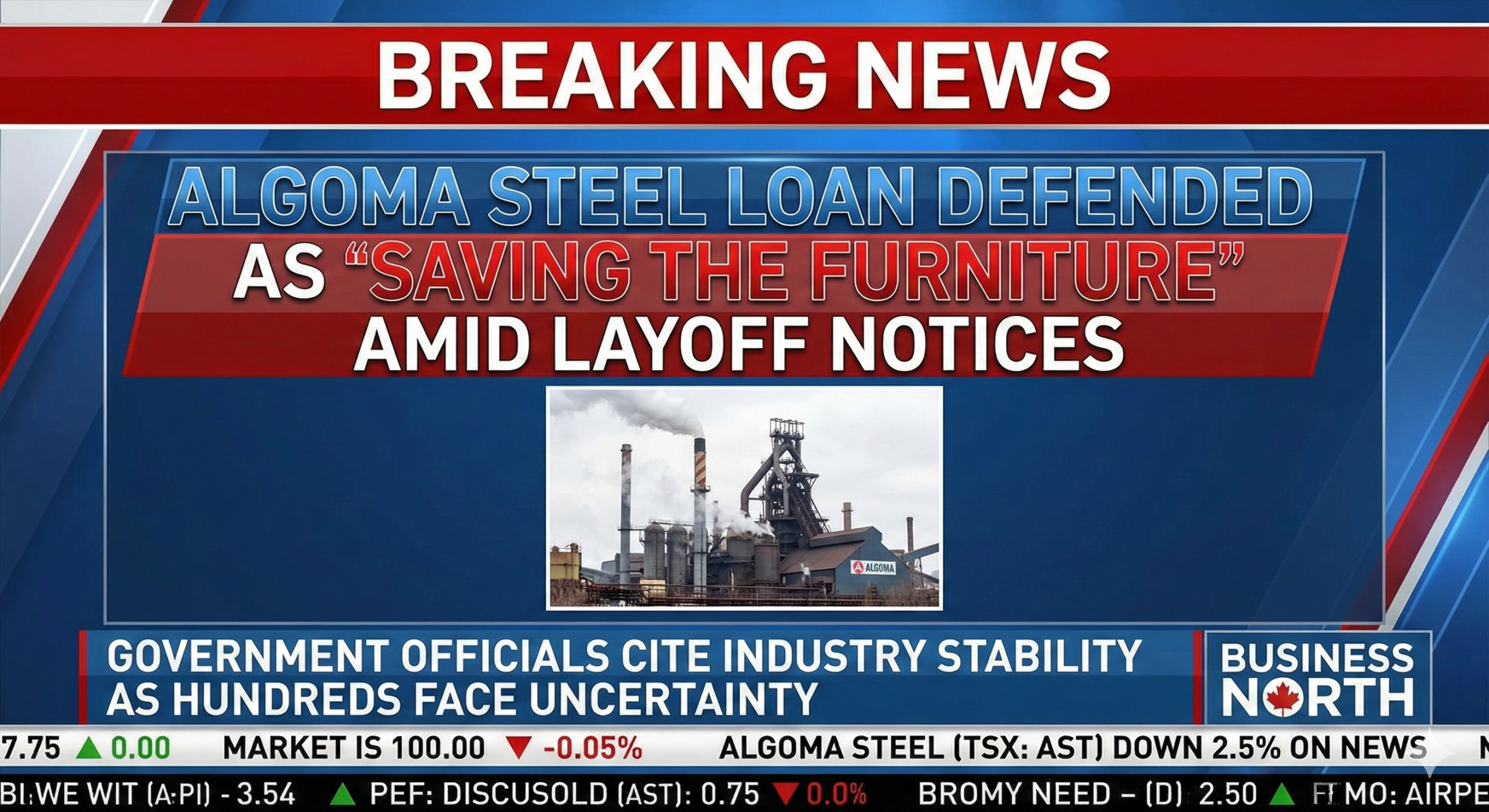
Government frames loans as strategic rescue, critics call for accountability
The federal government is defending its decision to provide nearly half a billion dollars in loans to Algoma Steel even as the company issues layoff notices affecting roughly 1,000 workers. Jobs and Families Minister Patty Hajdu told CTV Question Period the intervention was intended to preserve Canada’s sovereign steel capacity and give the company time to pivot to new products and markets — language that underscores a tension between short-term job impacts and long-term industrial strategy.
Ottawa and Ontario together extended $500 million in financing—$400 million from the federal government and $100 million from Ontario—after global market pressure, including U.S. steel tariffs, threatened the sector. Yet the revelation that government officials were aware the company’s retooling plan would involve layoffs has prompted questions about transparency, timing and the conditions attached to public funds.
What the loan covers — and why layoffs followed
Algoma, the nation’s last independent steel producer, has been transitioning to Electric Arc Furnace (EAF) technology, a shift the company characterizes as more cost-effective, flexible, and less labour-intensive than traditional blast furnace operations. The EAF transition requires shutting down existing blast furnace and coke oven facilities — a move the company originally planned for 2027 but accelerated in response to tariffs and shifting market dynamics.
Last week Algoma issued layoff notices to about 1,000 employees, effective in March. The company employs approximately 2,700 people in Sault Ste. Marie and surrounding areas. CEO Michael Garcia told CTV’s Power Play that both federal and provincial governments were informed of the company’s business plan — including the likelihood of job reductions — during financing discussions.
So what did Ottawa know, and when? The government has acknowledged awareness of the retooling strategy, but ministers emphasize that the loans were meant to provide breathing room for Algoma to adapt to sudden trade pressures and to protect Canada’s steel-making capacity. Hajdu described the intervention bluntly: “This is about saving the furniture in the steel industry,” she said — a phrase that captures the stakes as Ottawa sees them, but which also invites debate about which pieces of furniture are being saved and at what cost.
Government response: transparency, trade-offs and support measures
“Eyes wide open” but what of guarantees?
Hajdu says the government proceeded “eyes wide open,” recognizing disruption would occur but asserting the loans were necessary to give Algoma time to pivot. She argued the investment aims to position a Canadian steelmaker to find new markets and produce new products — outcomes seen as strategically important given that 90 per cent of Canada’s steel exports went to the U.S. in 2024, exposing the sector to American trade policy.
When pressed why Canadians were learning about layoffs from Algoma rather than Ottawa, Hajdu insisted that the government has been transparent about the industry’s precarious position and the rationale for intervention. Still, critics and some opposition voices argue the sequence of events — financing followed by layoff notices — looks like a policy failure in either communication or conditionality.
Job protections and future loans: answers avoided
The minister would not commit to requiring job guarantees in future loans, nor would she say the government is prepared to provide more funding if further cuts occur. Instead, she highlighted complementary measures such as temporary Employment Insurance (EI) extensions and other worker supports introduced earlier in the year to mitigate tariff-driven layoffs in steel, auto and forestry sectors.
Hajdu said future decisions about additional financial support would be made “one at a time,” and that Algoma must show evidence the loan is enabling a transition to viable new products and markets. That conditionality — cited by ministers — will be closely watched by labour groups and regional stakeholders seeking concrete commitments on job retention, re-skilling and community supports.
Industry context: tariffs, market shocks and structural change
The timing of Algoma’s retooling accelerated after the U.S. imposed a 50 per cent tariff on steel imports, a shock that has forced many Canadian producers to rethink market access and competitiveness. The federal government responded with new measures intended to restrict foreign steel imports from countries without free trade agreements and to reduce quotas from some trading partners — policy moves designed to shore up domestic producers.
At the same time, the steel industry is undergoing structural shifts toward lower-emissions, more flexible production methods such as EAF. These technologies are less labour-intensive by design. For regions dependent on traditional steelmaking jobs, that transition raises deep questions about economic diversification, retraining and the timeline for community adjustment.
Local and labour reaction: worry, pragmatism, and demands for clarity
In Sault Ste. Marie, the layoff notices landed hard. For many workers and families, the loss of income and the prospect of longer-term local economic pain are immediate concerns. Labour advocates and municipal leaders are seeking clarity on what the loan terms require Algoma to do for affected workers, and what provincial-federal co-ordination will look like to deliver training, redeployment and economic development supports.
Algoma’s leadership frames the move as necessary for survival in a changing market. For workers and their communities, the question is whether the financial lifeline ultimately preserves a durable industrial presence or simply delays and reshapes job losses without adequate supports.
What happens next: timelines, conditions and political risk
Algoma has indicated the loan funds are to be used to pivot production and reach new customers. The government says it will require evidence that this pivot is occurring. Exact timelines, milestones and enforcement mechanisms for those conditions have not been fully disclosed.
Politically, the file exposes Ottawa to criticism from multiple fronts: labour and municipal leaders concerned about job losses; opponents who see the loans as corporate welfare without sufficient strings; and industry stakeholders watching how trade policy and domestic supports evolve. If Algoma is unable to demonstrate a credible transition and job outcomes worsen, the government may face intense scrutiny over whether public funds achieved their stated objectives.
Conclusion: a delicate balancing act between industry survival and worker protection
The Algoma Steel loan exemplifies the hard trade-offs governments face during sectoral shocks: intervene to preserve national industrial capacity, or step back and let market forces dictate outcomes — with significant local social costs. Ottawa chose intervention, arguing the loans provide crucial breathing room to pivot toward a more sustainable, competitive future. But the arrival of mass layoff notices shortly after the funding announcement has left workers, communities and some policymakers asking whether the support came with adequate protections or foresight.
As the situation unfolds, two questions will matter most: will Algoma use the funds to secure a viable, employment-supporting future for Canadian steelmaking? And will the federal government ensure that public money translates into clear benefits for workers and communities, not merely a reallocation of industrial risk? The answers will determine whether the loan is remembered as a prudent rescue, or as an intervention that missed the human cost of industrial transformation.
Leave a Reply