Introduction: A Law Under Growing Scrutiny
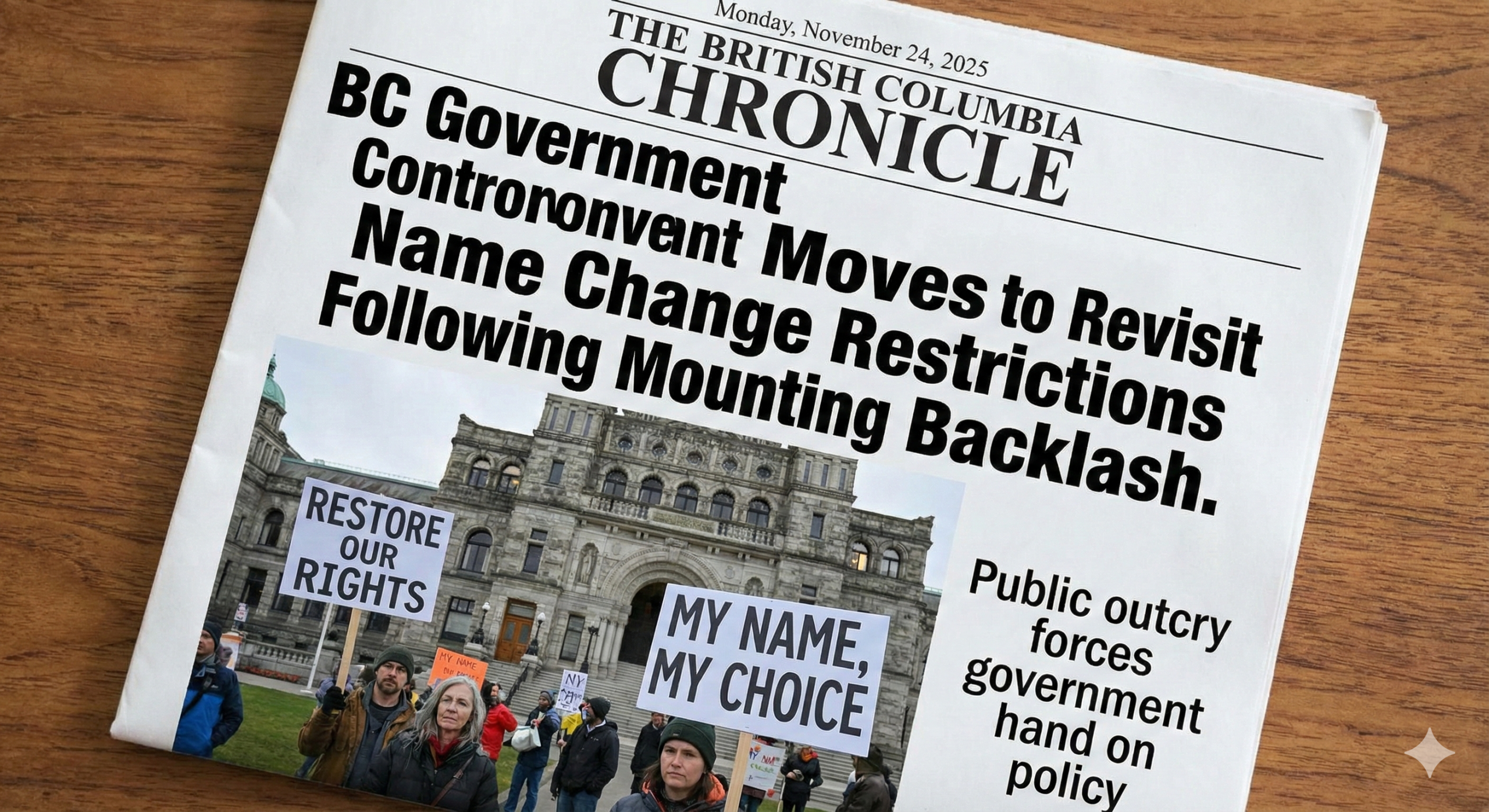
The government of British Columbia is preparing to re-examine a highly contentious law that restricts certain individuals from legally changing their names, following strong opposition from within its own party and widespread criticism from advocacy groups. The decision comes after delegates at the BC NDP convention unanimously passed a resolution urging the repeal of restrictions introduced under the Name Amendment Act in 2024. Premier David Eby has confirmed that the province will conduct a review of the legislation to address unintended consequences while preserving what he describes as its core public safety objective.
The move has reignited debate across the province over the balance between safeguarding communities and protecting the rights and dignity of vulnerable individuals, including Indigenous peoples, transgender individuals, and survivors of violence.
Origins of the Name Amendment Act
Law Introduced Amid Public and Political Pressure
In May 2024, the BC government passed the Name Amendment Act, which prohibits certain individuals from legally changing their names if they have been convicted of specific criminal offences, declared dangerous or long-term offenders, or found not criminally responsible due to mental disorder. Additionally, the legislation requires anyone over the age of 12 to undergo a criminal record check within 30 days before applying for a legal name change through the Vital Statistics Agency.
The policy was introduced following political pressure from the official Opposition and public outcry over revelations that Allan Schoenborn — who was found not criminally responsible for killing his three children in 2008 — had legally changed his name in 2021. The case heightened concerns that people with serious criminal histories could use name changes to obscure their past and evade accountability.
NDP Delegates Push for Repeal
Unanimous Vote Signals Party Discontent
At the recent BC NDP convention, party delegates voted unanimously in favour of rescinding the name-change restrictions. Adrienne Smith, chair of the party’s Sexual Orientation and Gender Identity (SOGI) committee, delivered a forceful speech condemning the law and highlighting its far-reaching consequences.
Smith pointed out that every Member of the Legislative Assembly supported the law at the time, regardless of political affiliation, but acknowledged that it has proven deeply flawed in practice. She described the legislation as a mistake that has resulted in lengthy delays of more than a year for name change applications, further compounding hardships for those seeking legal recognition of their identities.
Concerns Over Misguided Fear and Legal Inefficiency
Smith, who is also a practicing lawyer, argued that the law is grounded in an unfounded fear that name changes could enable individuals to hide criminal histories. She emphasised that existing governmental tools such as fingerprint identification and criminal background checks are already sufficient to prevent misuse of the process. According to the SOGI committee report, hiding a criminal record through a name change is not realistically possible under current systems.
Impact on Vulnerable Communities
Transgender and Gender-Diverse Individuals
One of the most affected groups are transgender and gender-diverse individuals who rely on legal name changes to align their identity documents with their gender identity. Failure to update legal names often leads to misgendering, discrimination, and emotional distress, especially in healthcare, education, and employment settings.
Advocates argue that the new restrictions create barriers that compromise safety and dignity, particularly for young trans people who must navigate systems already fraught with misunderstanding and stigma.
Indigenous Peoples Seeking Cultural Reclamation
The law has also raised alarm among Indigenous communities, where name changes are often part of reclaiming traditional identities that were forcibly erased through colonial systems. Preventing individuals from restoring Indigenous names undermines broader reconciliation efforts and hampers cultural continuity.
Survivors of Violence and Exploitation
Survivors of gender-based violence and intimate partner abuse frequently seek name changes as part of their efforts to start anew and escape dangerous situations. Advocacy groups warn that forcing survivors to retain names tied to their past abusers can compromise their safety and prolong trauma.
The party’s women and gender rights committee echoed these concerns, stating that the restrictions could potentially trap survivors in vulnerable positions, increasing the risk of being located by their abusers.
Broader Social and Economic Consequences
Barriers to Reintegration and Opportunity
Morgane Oger, former NDP candidate and ex-official with the Vancouver Pride Society, voiced strong opposition to the policy, describing it as socially damaging. She argued that the ban effectively turns past convictions into permanent obstacles, preventing people from rebuilding their lives and accessing essential services such as housing, employment, healthcare, and education.
Oger stressed that those most affected are already disproportionately targeted by the justice system, compounding systemic inequalities and marginalisation.
Unequal Treatment and Exemptions
Another major criticism lies in the exclusion of name changes through marriage or adoption from the law’s restrictions. Critics argue that this reveals an inconsistency that preserves traditional norms while denying fundamental dignity to others. Advocates say if name changes pose a risk, the rules should apply equally across all categories.
Government Response and Review Strategy
Premier Eby’s Balanced Approach
Premier David Eby has acknowledged the concerns raised by party members and advocacy groups but reaffirmed the government’s commitment to the law’s original intention — preventing individuals from avoiding accountability through name changes.
He cited the example of a Kelowna student who wished to ensure her identification reflected her true name and gender before beginning studies in the United States, demonstrating how unintended consequences can significantly impact ordinary citizens.
Eby emphasised that the government would consult affected communities to correct flaws in the legislation without compromising its foundational principle of public protection.
Ministerial Oversight and Responsiveness
Citizens’ Services Minister Diana Gibson confirmed that extensive consultations would take place with stakeholders and affected individuals. Having recently taken over responsibility for Vital Statistics, Gibson expressed commitment to reviewing the implications of the law and ensuring that the government’s approach aligns with fairness and compassion.
She noted that while initial engagement had already occurred, the current review would be more comprehensive and focused on achieving the right balance between safeguarding public safety and preserving individual rights.
Opposition Voices and Political Division
Conservative Party Criticism
The Conservative Party of BC has strongly opposed the NDP’s resolution, describing it as reckless and dangerously lenient. Party leader John Rustad warned against any move that could potentially allow individuals with criminal histories to conceal their past.
According to Rustad, no circumstances should permit someone with a criminal record to modify their identity in a way that could distort public accountability or endanger community safety.
Persistent Ethical Debate
The issue continues to stir ethical and political debate, reflecting broader societal tensions around criminal justice reform, human rights, and the scope of government oversight. While critics prioritise security, supporters argue that dignity and rehabilitation must remain central to modern governance.
Expert Opinions on Criminal Record Transparency
Legal analysts maintain that modern identification systems ensure traceability regardless of name changes. Criminal records remain linked to biometric data, and government agencies retain full access to historical identities. This, they argue, makes fears of evasion largely unfounded and reinforces the argument for revising restrictive policies.
Conclusion: Toward a More Equitable Framework
As British Columbia prepares to review its Name Amendment Act, the unfolding debate underscores the challenges of crafting legislation that safeguards public safety while upholding human dignity. The government now faces increasing pressure to amend policies that disproportionately affect vulnerable populations and undermine the very principles of inclusion and rehabilitation it strives to protect.
Premier Eby’s commitment to dialogue and balanced reform signals a crucial moment in the province’s governance. Whether the law is ultimately revised or restructured, the process will likely redefine how British Columbia navigates identity rights, justice, and social equity in the years ahead.
This review carries profound implications not only for those directly affected but also for the broader vision of a just, compassionate, and inclusive provincial framework — one that recognises that a name is far more than a label, but a foundational expression of identity, dignity, and belonging.
Leave a Reply