Introduction: A Controversial Legal Move With Deep Human Impact
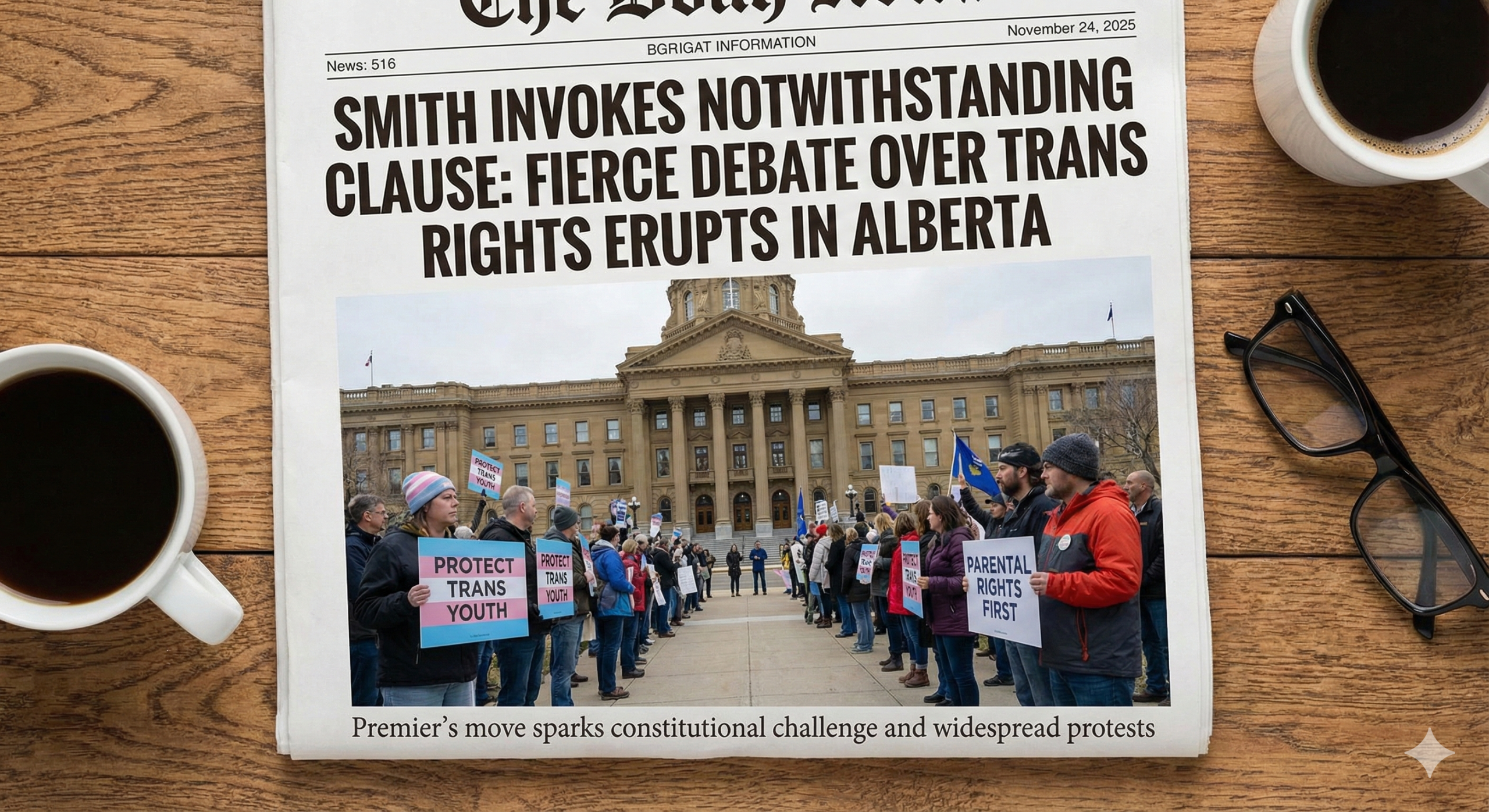
Alberta Premier Danielle Smith has ignited a national firestorm by invoking one of the most powerful and contentious tools in Canadian law — the notwithstanding clause — to ensure her government’s suite of legislation targeting transgender youth remains in force. Through the introduction of Bill 9, formally known as the Protecting Alberta’s Children Statutes Amendment Act, the provincial government has chosen to override Charter protections in order to prevent courts from striking down three laws introduced last year that restrict access to gender-affirming care and limit the rights of trans students in schools and sports.
Critics argue this move places ideological and political priorities above the health, safety, and dignity of transgender children. Supporters, meanwhile, insist the legislation is about safeguarding minors. At the centre of the debate lies a fundamental question: should governments be allowed to suspend constitutional protections to push through policies that directly affect vulnerable communities?
What Is the Notwithstanding Clause and Why It Matters
A Rarely Used Override of Charter Rights
The notwithstanding clause, enshrined in Section 33 of the Canadian Charter of Rights and Freedoms, allows federal or provincial governments to override certain Charter rights for a renewable period of five years. Once invoked, courts are effectively barred from invalidating the law, even if it infringes on fundamental freedoms such as equality rights or personal autonomy.
By using this mechanism, Alberta’s government has ensured that its anti-trans legislation will remain in place regardless of any legal challenge from rights groups, families, or advocacy organizations. This decision has triggered widespread concern among constitutional experts who warn that such a move sets a dangerous precedent for bypassing judicial oversight.
The Laws at the Heart of the Dispute
Restrictions on Gender-Affirming Health Care
One of the most contentious elements of the legislation limits access to gender-affirming medical care for minors, including puberty blockers and certain surgical procedures. The government claims these measures are necessary to protect children from making irreversible decisions they may later regret.
Medical professionals and major health bodies dispute this narrative, emphasizing that gender-affirming treatments follow strict clinical guidelines, involve extensive assessment processes, and are widely regarded as life-saving for many trans youth. Numerous studies have linked access to such care with lower rates of depression, anxiety, and suicide among transgender adolescents.
School Pronouns and Participation in Sports
The laws also regulate how trans students are addressed in schools and restrict their participation in gendered sports categories. Opponents say these policies undermine students’ mental well-being by denying them autonomy and recognition in identifying as who they are.
The Premier’s Defence and the Accusations of Misinformation
Framing the Issue as Child Protection
Premier Smith has repeatedly defended her government’s stance by framing the legislation as a necessary step to protect vulnerable youth. She has cited concerns over fertility, long-term health risks, and competitive fairness in sports, portraying the laws as a shield against what she describes as rapid and misguided social change.
However, advocacy groups and medical experts argue that many of these claims are based on outdated research or misrepresented facts, calling into question the credibility of the government’s justification.
Fact Check: Separating Claims From Reality
H3: Top Surgery Is Not a Sterilization Procedure
During a recent press briefing, Smith suggested that procedures such as mastectomies — commonly referred to as top surgery — are “sterilizing” measures for teenagers. This assertion has been widely criticized by medical professionals, who confirm that top surgery does not impact reproductive organs or fertility.
Trans men and non-binary individuals who have undergone top surgery have gone on to have biological children, just as thousands of cisgender women who have had mastectomies or breast reductions for medical reasons have done. Labeling this procedure as sterilizing is not only inaccurate but also contributes to fear-based rhetoric surrounding trans health care.
H3: Puberty Blockers and Medical Consensus
Another repeated claim is that puberty blockers are unsafe and irreversible. In reality, these medications have been used for decades in pediatric care to treat precocious puberty and are considered fully reversible in most cases. When discontinued, typical pubertal development resumes.
Major organizations such as the Canadian Paediatric Society and the World Professional Association for Transgender Health support their cautious use under medical supervision, describing them as a critical tool in reducing gender dysphoria and psychological distress.
Impact on Trans Youth and Families
Emotional, Psychological, and Social Consequences
For trans youth, these laws go far beyond politics. They directly influence mental health, self-esteem, and physical safety. Families with transgender children report increased anxiety, fear of discrimination, and difficulty accessing essential medical and social supports.
Mental health professionals warn that denying affirming care puts young people at higher risk of depression, self-harm, and suicide. By legislating against medical best practices, critics argue that the government is placing ideology ahead of evidence-based care.
Legal, Political, and Social Backlash
Response From Rights Groups and Legal Experts
Civil liberties organizations, LGBTQ2S+ advocacy groups, and legal scholars have strongly condemned the use of Bill 9. Many argue that invoking the notwithstanding clause in this context erodes the very purpose of the Charter, which exists to protect minorities from majoritarian overreach.
National Implications
The Alberta government’s actions are being closely watched across Canada. Experts warn that if this approach goes unchallenged, it could embolden other provinces to use similar tactics on contentious social issues, weakening Charter protections overall.
A Broader Cultural and Ethical Debate
Whose Rights Take Priority?
The controversy highlights a deep divide between those who view trans rights as fundamental human rights and those who believe government intervention is necessary to maintain traditional social norms. At its core, the debate is about whether personal identity and health decisions should be governed by lawmakers or by individuals, families, and qualified medical professionals.
Conclusion: A Defining Moment for Canadian Democracy
Danielle Smith’s decision to invoke the notwithstanding clause marks a significant moment in Canadian political history. By prioritizing legislative power over constitutional protection, the Alberta government has thrust the nation into a critical conversation about civil liberties, minority rights, and the limits of political authority.
While the government maintains that its actions protect children, growing evidence and professional consensus suggest otherwise. For many, this issue represents not just a policy disagreement, but a moral test of Canada’s commitment to equality, compassion, and the protection of its most vulnerable citizens.
As legal challenges, public protests, and political discourse continue, one thing is clear: the consequences of this decision will be felt far beyond Alberta, shaping the future of human rights in Canada for years to come.
Leave a Reply