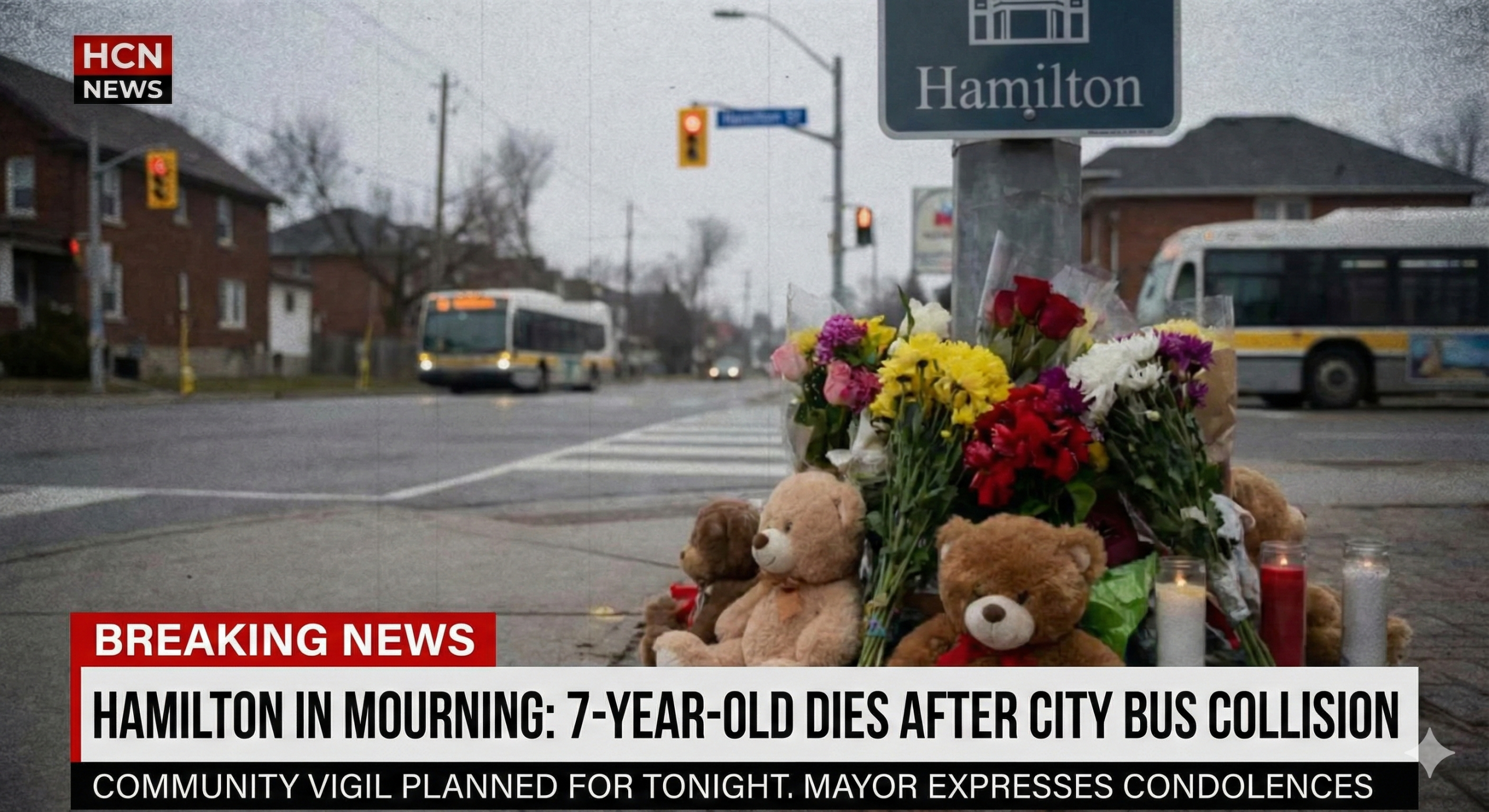
A City Confronts a Devastating Loss
Hamilton is grappling with profound grief after a 7-year-old child died from injuries sustained when they were struck by a city bus on Thursday afternoon. What began as an ordinary weekday in the city’s downtown core quickly shifted into a scene marked by emergency crews, road closures, and a heartbreaking silence that settled over the community.
The collision has triggered a comprehensive investigation by Hamilton police and their Collision Reconstruction Unit, while residents, city officials, and first responders struggle to process a tragedy that unfolded in a space many travel through every day. As Mayor Andrea Horwath put it, “Hamilton is grieving”—a sentiment that now echoes across neighbourhoods, workplaces, and public transit routes.
The Incident: A Timeline of What Authorities Know So Far
A Routine Bus Ride Turned Tragic
The collision occurred just after 1 p.m. in the area of Emerald Street and Wilson Street—an intersection surrounded by active construction on both sides. The bus involved belonged to the Hamilton Street Railway (HSR), the city’s public transit operator.
Police confirmed that approximately 15 passengers were onboard the bus at the time. Early details suggest the child may have been with their mother and that the pair had just exited the vehicle before the collision occurred. Investigators have not yet determined whether the child was struck by the front or the side of the bus.
Emergency crews were dispatched immediately. The child was transported to hospital, but despite medical efforts, they later died from their injuries.
A Driver Who Stayed at the Scene
Police say the bus driver remained on-site following the collision and is cooperating fully with the investigation. In incidents of this nature, driver presence and cooperation are crucial to helping reconstruct the sequence of events that led to the impact.
Construction activity in the area adds a further layer of complexity for investigators. Images captured at the scene show work zones bracketing both sides of Wilson Street, a factor that may have influenced visibility, pedestrian movement, or traffic patterns at the time.
A Community Struck to Its Core
City Leaders Respond
Mayor Andrea Horwath issued a statement expressing deep sympathy for the family and acknowledging the emotional weight now felt citywide.
“The loss of a child is unimaginable,” she said, pointing to the profound heartbreak that comes with tragedies of this nature. She also extended her gratitude to the first responders and investigators working at the scene—individuals who, despite witnessing trauma in their professional roles, rarely walk away unaffected.
Her message underscored a shared sentiment: moments like this ripple far beyond the immediate vicinity. They touch residents, transit staff, emergency personnel, and countless others who begin to reflect on safety, circumstance, and fragility.
A Fictional but Relatable Glimpse of Community Grief
Incidents involving children have a way of leaving entire cities shaken. A longtime Hamilton resident I once spoke with—a retired teacher—once told me, “Whenever something happens to a child, it feels like the whole city holds its breath.” She said it after a previous major incident in the community, and her words hang heavy once again today.
She described the way parents tend to clutch their kids’ hands a little tighter the next day. How neighbours check in on one another more often. How even casual interactions at the grocery store feel more tender. Her reflections echo the sentiment of author Mitch Albom, who once wrote that “When you lose a child, you lose the future.” The emotional impact stretches far beyond those who knew the young victim personally.
The Weight of Unanswered Questions
Public responses to this tragedy also show how quickly questions form in the wake of sudden loss: Was visibility impacted by construction? Were pedestrian signals functioning normally? Could anything have prevented this?
Some questions will eventually find answers through the reconstruction process. Others may never feel fully resolved. And, in moments like this, many simply want reassurance that future tragedies can be prevented.
The Investigation: What Comes Next
Collision Reconstruction Unit Takes Over
Hamilton police have asked the public to avoid the area while investigators meticulously piece together the timeline of events. The Collision Reconstruction Unit uses measurements, surveillance footage, onboard bus systems, witness statements, and physical evidence to build a technical understanding of what occurred.
Wilson Street, from Tisdale Street to East Avenue, is expected to remain closed for several hours—an indication of the level of detail investigators must capture. These scenes often require precise documentation, especially when pedestrian movement is involved.
Why These Investigations Matter
Determining the cause of a collision involving public transit is essential for several reasons:
-
Safety improvements: Findings can influence future intersection design, construction protocols, or bus operator procedures.
-
Accountability: Investigations help ensure fairness for everyone involved, including operators, passengers, and families.
-
Community confidence: Transparent, thorough investigations help restore public trust in the transit system and city infrastructure.
In tragedies involving young children, the public attention is even more intense. People want to know what happened, whether systemic issues played a role, and what will change as a result.
Leave a Reply