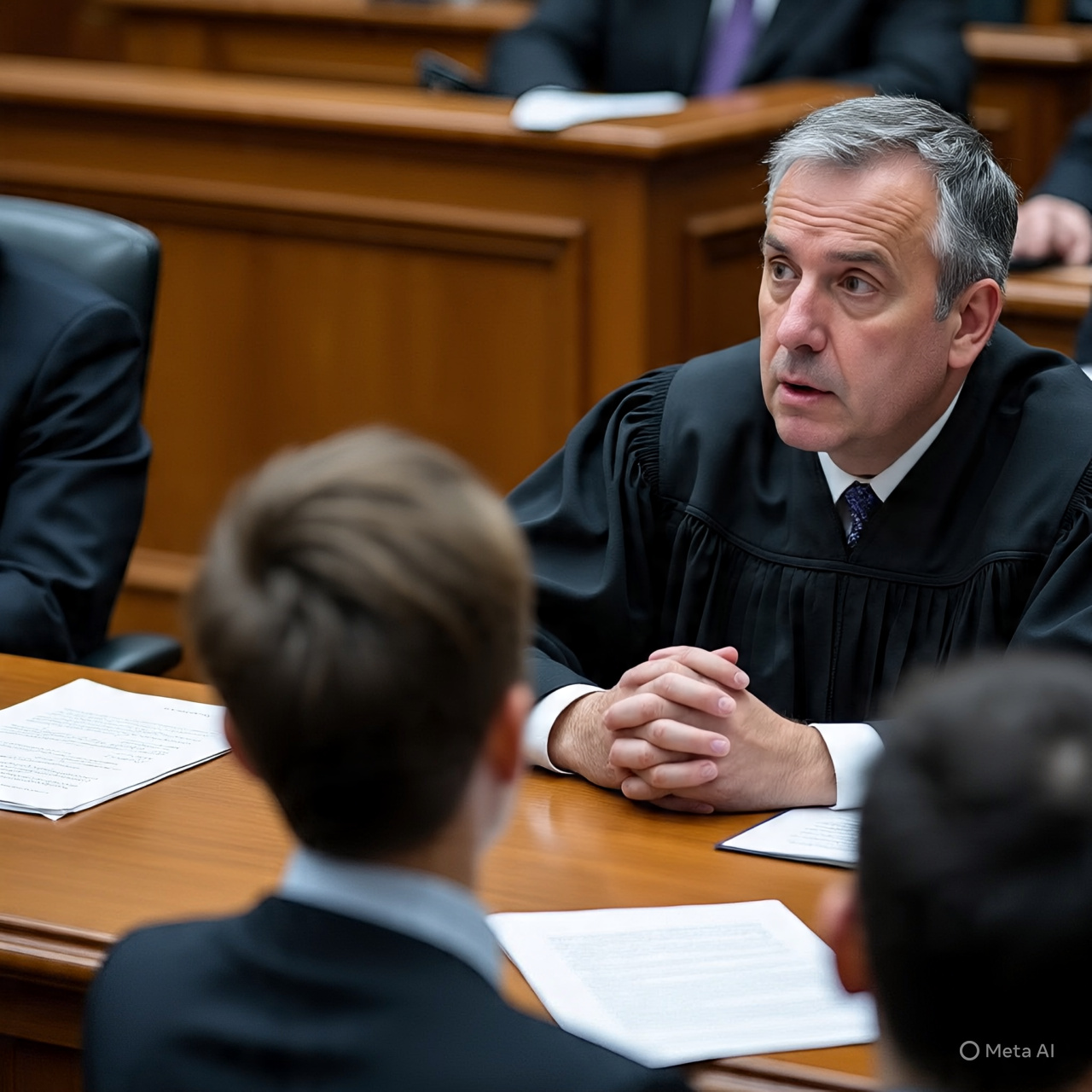
Co-Accused Faces Intense Cross-Examination as Testimony Shifts in Milton Court
The murder trial of two Burlington women accused in the death of a 12-year-old boy took a disturbing turn on Tuesday as the Ontario Superior Court in Milton heard graphic descriptions of confinement, surveillance, and prolonged restraint used on two Indigenous brothers under their care.
During her second day on the stand, Brandy Cooney—one of the two women charged—faced rigorous cross-examination that challenged the credibility and consistency of her earlier testimony. The courtroom was presented with details alleging that the brothers were locked in their bedrooms for up to 18 hours at a time, placed in zip-tied wetsuits and tube-like sleep sacks, confined with helmets, and monitored through an elaborate setup of bells, chimes, and cameras.
Cooney and her wife, Becky Hamber, are jointly charged with first-degree murder in the death of 12-year-old L.L., as well as confinement, assault with a weapon, and failing to provide the necessaries of life to his younger brother, J.L. Both women have pleaded not guilty to all charges.
A Disturbing Pattern of Control Revealed in Court
Brothers Locked in Bedrooms for Long Periods
According to testimony presented Tuesday, the two boys spent extended periods locked in their bedrooms, sometimes for as long as 18 hours. This practice allegedly took place during the final year that the brothers lived with Cooney and Hamber.
Cooney acknowledged that both boys were confined regularly, but insisted the measures were intended to protect them from harming themselves. Her explanation, however, shifted notably under questioning from the Crown.
Zip Ties, Wetsuits, Sleep Sacks, and Helmets
The court heard that the children were restrained in various ways, including being placed inside wetsuits or sleep sacks that were zip-tied shut. In some cases, their helmets were also zip-tied onto their heads to prevent what the women described as self-harming behaviour.
These practices—combined with locking the boys in their rooms—formed a pattern of nightly control that the Crown alleges contributed directly to L.L.’s death in December 2022. At the time of his death, the 12-year-old was so severely malnourished that he weighed the same as he had at age six, a fact the court has previously heard since the trial began in mid-September.
Cooney’s Testimony Shifts Under Crown Scrutiny
Monday’s Account vs. Tuesday’s Cross-Examination
On Monday, during questioning by the defence, Cooney had insisted that restraints were rarely used and that she and her wife “loved and cared” for both boys. She claimed that the children displayed volatile behaviour, describing explosive tantrums and destructive episodes that allegedly included urinating and defecating throughout the home.
She also stated that she “never” restrained the younger brother, J.L., except for a single incident in which she held him for seven hours as a form of comfort.
However, when assistant Crown attorney Monica MacKenzie began cross-examining her on Tuesday, Cooney’s narrative began to shift. Under repeated questioning, she conceded that she and Hamber regularly restrained both boys.
“Yes, I Did Use a Jacket” — A Shift in Tone
In a striking moment, Cooney admitted that she used a jacket to prevent one of the boys from choking himself. She also acknowledged that the sleeves of their wetsuits were zip-tied closed to stop them from using their hands to self-harm.
“Yes, I did use a jacket, so he didn’t try to choke himself and die,” she said during questioning. “And yes, I did zip-tie the end of [their wetsuit] sleeves to stop them from using their hands to choke themselves out.”
These admissions contrasted sharply with her earlier testimony and raised questions about whether the restraints were used as protection or punishment—or as a consistent form of control.
Constant Surveillance Inside the Home
Cameras in Nearly Every Room
Cooney testified that she and Hamber installed cameras throughout most rooms in their Burlington home. These cameras transmitted live footage to their phones, which they monitored “much of the day,” she said.
Bells and Chimes to Track Movement
Beyond the cameras, the women allegedly used bells, chimes, and other monitoring devices to track the boys’ movements at night. Bells were strung across J.L.’s bed so they could hear when he moved. Chimes were suspended above doors so the women would be alerted if either boy entered or exited a room.
The Crown argued that the level of surveillance suggested a home environment built around strict control rather than care. Cooney maintained that the purpose was safety, though she conceded under questioning that the boys were restrained “at times” more frequently than she had previously stated.
Claims of Self-Harm Rarely Substantiated by Others
A Gap Between Reported Behaviour and Outside Observations
Throughout the years leading up to L.L.’s death, Cooney and Hamber repeatedly told the Children’s Aid Society (CAS), teachers, doctors, and therapists that the boys displayed extreme self-harming and aggressive behaviours.
However, the Crown highlighted Tuesday that these behaviours were “rarely, if ever” observed by anyone outside the home.
This discrepancy formed a significant component of the Crown’s strategy. Assistant Crown attorney MacKenzie suggested that the women’s descriptions of uncontrollable behaviour might have been exaggerated or fabricated to justify the use of restraints.
Text Messages Reveal Their Definition of “Bad Behaviour”
8,000 Pages of Messages Entered into Evidence
The Crown introduced excerpts from more than 8,000 pages of text messages exchanged between Cooney and Hamber. These messages, the prosecution said, revealed how the women perceived the boys’ behaviour and how often they referenced controlling or restricting them.
The texts, according to the Crown, included examples of what the women considered “bad behaviour,” which at times appeared inconsistent with the serious allegations of self-harm and violent tantrums they reported to authorities.
While the courtroom did not hear every detail of the messages on Tuesday, the reference to their volume signaled a broader strategy: to demonstrate a long-term pattern of controlling behaviour and to challenge the credibility of the women’s claims that restraint was used only as a last resort.
A Case That Continues to Raise Difficult Questions
A System Under Scrutiny
The trial has raised ongoing concerns about the oversight of children in care, the responsibility of caregivers, and the mechanisms meant to protect vulnerable youth. The boys had been living with Cooney and Hamber since 2017, and the circumstances of L.L.’s death have led to broader questions about how warning signs may have been missed.
A Story Far From Over
The trial, now months underway, is expected to continue revealing difficult details in the weeks ahead. With the Crown aggressively challenging Cooney’s credibility, and with thousands of text messages and additional testimony yet to be fully explored, the court is still working to uncover what truly happened inside the Burlington home before L.L.’s death on December 21, 2022.
Leave a Reply