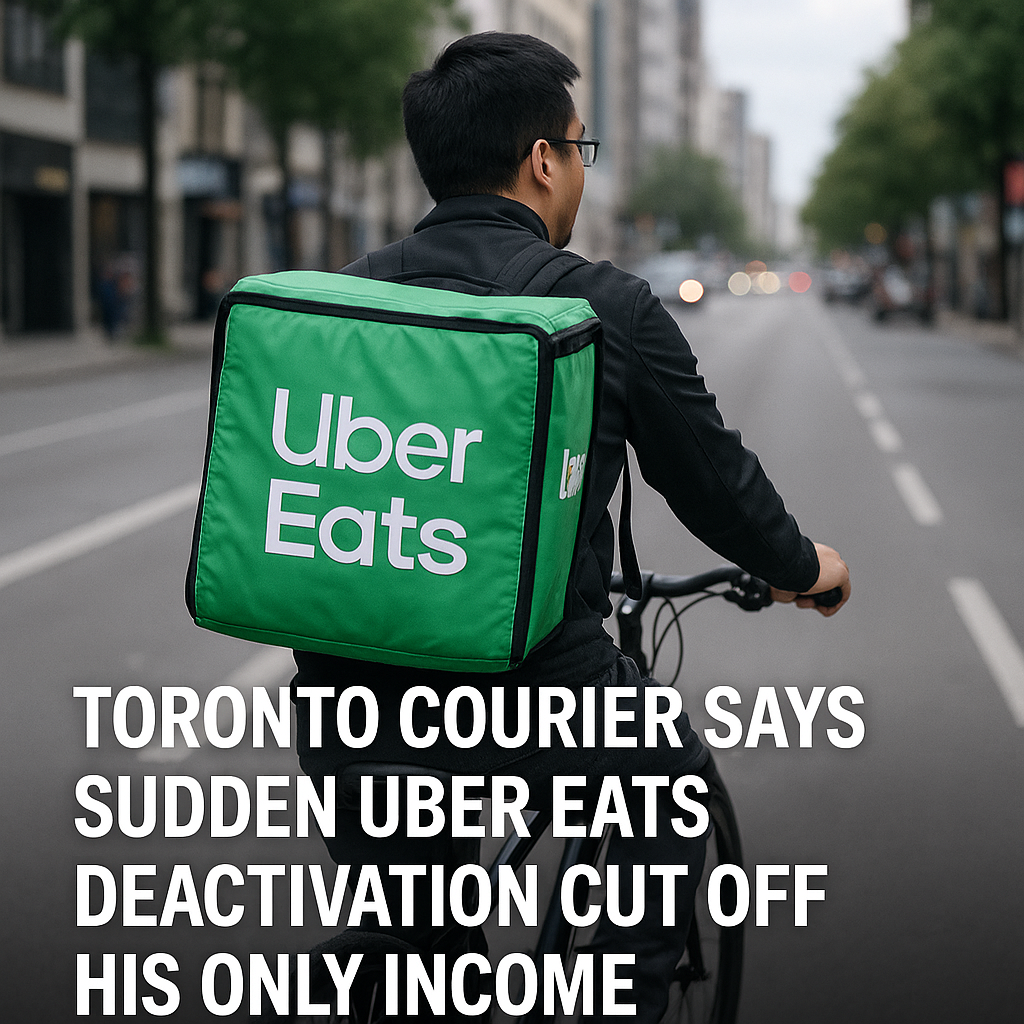
A Longtime Delivery Worker Faces an Unexpected Roadblock
In Toronto’s dense patchwork of neighborhoods, where delivery riders weave through traffic like determined messengers on a mission, one courier says he suddenly found himself locked out of the job that had shaped his daily life. According to 28-year-old Nan You, an abrupt account deactivation by Uber Eats not only halted his work but also severed the financial lifeline he had relied on for years.
His experience raises tough questions about platform transparency, the vulnerability of gig workers, and the thin line between operational safeguards and unintended consequences. It also mirrors anxieties circulating widely in the app-based workforce: What happens when your livelihood depends on a digital account you don’t control?
Four Years, 14,000 Deliveries—and Then a Single Notification
A Career Built on Reliability
You had been delivering for the platform for more than four years, logging more than 14,000 completed trips and keeping an impressive satisfaction rating of 98 percent. The numbers reflect a courier who did not treat the role as a temporary side hustle but rather as a full-time profession. For him, the job was straightforward—hard work, long hours, and consistency.
He wasn’t exaggerating about the hours, either. By his own account, he put in a minimum of 80 hours each week. That is the type of schedule most people associate with startup founders, not cyclists hauling takeout orders through unpredictable Canadian weather. “I work 80-plus hours, minimum, 80 hours a week,” he said. It was relentless. It was exhausting. But it was stable—until it wasn’t.
A Notification That Changed Everything
On Monday, without any prior issues flagged, he opened the app to start his day. Instead of a new batch of orders, he received a message stating that his profile had been duplicated. As he understood it, Uber prohibits couriers from having more than one account, and the system had seemingly detected an additional profile linked to him. The result: permanent deactivation.
No details. No context. No explanation of how or why the duplication occurred.
And that, he says, is what stings the most. “I’m feeling really bad because first, I lost my job, and then second of all, this is my source of income,” he explained.
The Consequences of a Digital Decision
When Your Income Lives Inside an App
Gig-economy couriers often say the freedom to choose their own hours is a gift. But it’s also a trade-off. There’s no HR office down the hall. No union representative to call. No guaranteed paycheck. As You puts it, one automated notification can erase years of effort.
It’s a scenario thousands of gig workers hope they never face: the sudden realization that a platform decision—sometimes made by an algorithm—has the final say over whether you can work.
A Fictional But Familiar Parallel
A few summers ago, I met a courier named Julian while waiting for a coffee in downtown Toronto. He laughed while telling me he felt married to his delivery app. “It knows where I am more often than my girlfriend does,” he joked. Then, as comedians often do, he pivoted to a darker truth: “But if it ever leaves me, I’m doomed.”
He said it with a grin, but the point landed. The comedian George Carlin once quipped, “That’s why they call it the American Dream—because you have to be asleep to believe it.” For many gig workers, the dream of flexibility can feel just as fragile.
Julian’s lighthearted metaphor now echoes eerily in You’s story: When the app that watched every mile suddenly stops recognizing you, what happens next?
Understanding the Duplicate Account Issue
Why Platforms Monitor Duplicate Profiles
App-based companies implement strict identity policies to prevent fraud, protect customers, and ensure safety. Duplicate accounts can signal unauthorized use, account sharing, or attempts to circumvent performance metrics. From a business perspective, the guardrails make sense.
But as multiple gig-economy advocates have argued, automated detection systems don’t always distinguish between genuine wrongdoing and technical anomalies. In those moments, the burden of explanation often falls on the workers—freelancers who may not have the tools or visibility to prove their case.
Limited Transparency Fuels Frustration
What troubles You most is not just the deactivation, but the lack of clarity about what triggered it. When a courier’s identity or account status is questioned, detailed reasoning and human-led review can make the difference between a temporary disruption and a total loss of income.
His story underscores a structural tension: platforms emphasize efficiency, but workers need empathy, communication, and due process.
A Sudden Loss of Stability
The Weight of a Single Source of Income
You says the job wasn’t just a paycheck. It was a system he had built his life around. The routine gave him purpose, structure, and financial reliability. When that disappears without warning, the emotional and economic consequences can be severe.
Anyone who has experienced sudden job loss understands the gut-punch. But losing work through an app notification adds an extra twist. There’s no conversation with a supervisor. No chance to clarify. No opportunity to correct. Just a message—and then silence.
The Human Impact Beneath the Headlines
Imagine working through snowstorms, summer heatwaves, and late-night rushes for four years straight. Imagine building relationships with restaurant workers who recognize you, customers who appreciate your consistency, and a personal rhythm shaped entirely around a role you’ve mastered.
Then picture it all evaporating at the tap of a button. Wouldn’t you feel blindsided?
The Broader Gig-Economy Conversation
Why These Cases Draw Public Attention
Stories like You’s resonate widely because they highlight an essential truth: digital platforms are not just apps—they’re workplaces. And when workplace decisions lack transparency, workers are left with uncertainty and stress.
The debate is not about eliminating safety protocols or accountability. It’s about bridging the gap between algorithmic efficiency and human-centered decision-making.
A Growing Push for Clearer Policies
Advocates across cities have argued that gig workers need:
-
More detailed explanations for account actions
-
Access to appeals reviewed by real people
-
Advance warning when possible
-
Stronger mechanisms to contest errors
These measures, they argue, don’t hinder safety. They enhance trust.
Looking Ahead for the Toronto Courier
Seeking Answers and Hoping for Resolution
For now, You is still waiting for more clarity from the company. He wants to understand what happened, why it happened, and whether it can be resolved. More than anything, he wants the opportunity to work again.
His situation is a reminder that behind every delivery bag and bicycle helmet is a person managing bills, aspirations, and sometimes razor-thin financial margins. The gig-economy might be built on technology, but its consequences play out in human lives.
A Personal Chapter That Reflects a Larger Story
Despite the setback, You’s past performance and persistence suggest he is not someone who easily gives up. The sense of accomplishment he once felt from completing thousands of deliveries hasn’t vanished. Nor has the potential to rebuild—whether within the platform or beyond it.
As one might say, when a door closes, a window opens. Though in the gig-economy, sometimes it feels like you’re waiting for the app to unlock the window first.
Conclusion: A Case That Captures the Modern Work Landscape
Nan You’s experience highlights a defining tension of platform-based labor: the promise of independence paired with the risk of sudden instability. His sudden deactivation raises broader questions about fairness, communication, and the systems governing gig work.
It also spotlights the resilience of workers who handle the daily realities of long hours, unpredictable conditions, and digital gatekeepers. His story is not merely about a lost account—it’s about the earnest pursuit of stability in a world where the rules can shift without notice.
Leave a Reply