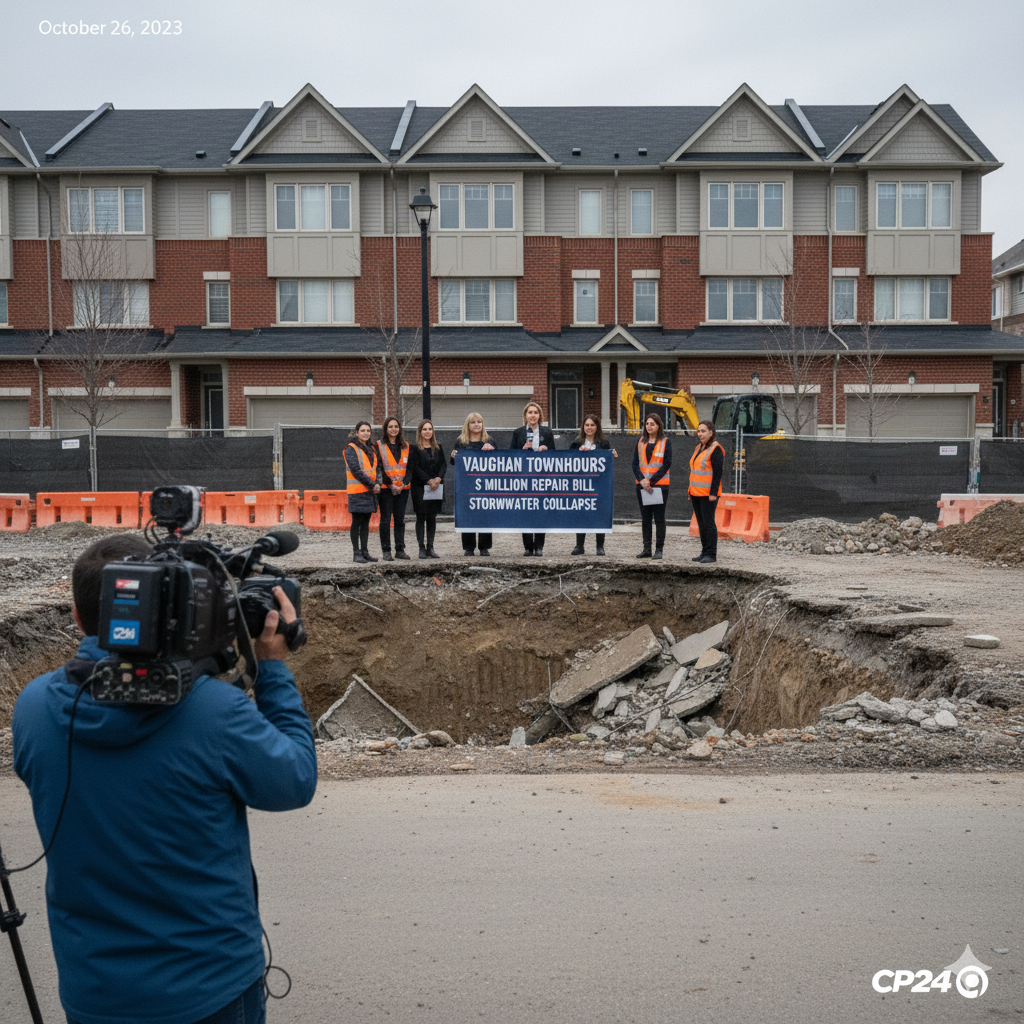
Several dozen townhouse owners in Vaughan, Ontario, are now confronting unexpected and steep repair costs — totaling nearly $2 million — after a stormwater system failure caused a playground collapse within their four-year-old complex. The residents say the incident has exposed serious gaps in homeowner protections in the province.
Young Homes, Old Problems
The residences in question belong to Arthur Townhomes, a development by Treasure Hill, located near Keele Street and McNaughton Road in Vaughan. Though 51 freehold units were completed in 2021 and sold individually, the community is governed by a condominium corporation that manages shared infrastructure — roads, utilities, common areas, and a small playground built atop a communal stormwater tank.
In June 2024, that playground suddenly collapsed when a sinkhole opened above the stormwater tank. The collapse tilted playground equipment, uprooted trees, and rendered the area unsafe. Thankfully, no children or residents were injured, but the shock and fear among owners was immediate.
Homeowners had anticipated living in a new, safe development — instead, many describe the past year as a “nightmare.”
From Playground Collapse to $40,000 Bills
What started as a frightening structural failure has turned into a significant financial burden on residents. The total cost to repair and replace the damaged stormwater infrastructure — spread across the 51 units — has climbed to nearly $2 million. That breaks down to roughly $40,000 per homeowner.
Initially, in August 2024, each owner was billed about $7,800 to fund engineering assessments and immediate site protection measures. But ongoing repairs, site stabilization, and reconstruction planning have meant continuing costs. In February 2025, a second special assessment of about $16,000 per unit was issued. Most recently, in November 2025, homeowners were asked to pay an additional $16,039, to be paid in three installments, to cover replacement of the water tank and other necessary structural work.
As one owner, Asta Law, lamented: she bought her home pre-construction expecting “stress-free” living; what she got was substantial financial instability. Another owner, Jarreau Hickson, described moving into the townhouse in 2021 with hopes of starting a family — only to be blindsided by a collapse and now paying tens of thousands of dollars in unexpected fees.
They argue: “If this could happen here, it could happen anywhere.”
What Went Wrong — And Who’s at Fault?
The condo corporation’s engineers’ report indicates that the underground stormwater tank was installed incorrectly: the “location and depth” did not match the approved construction drawings. Worse yet, during installation, makeshift wooden shoring was used temporarily — and reportedly left in place. Over time, the shoring failed, destabilizing the tank and triggering the collapse.
Yet despite these findings, the development’s insurer refused to cover the damages. In October 2025, after more than 16 months of investigation and after the condo corporation had already spent over $1 million on mitigation efforts, the claim was denied. The insurer cited privacy concerns and declined to comment on specifics.
When contacted, Treasure Hill rejected the findings of “incorrect installation,” stating that the tank was installed in accordance with the manufacturer’s guidelines. The developer’s representative said they are reviewing an engineering report from the insurer, and claimed the condo board has not yet formally engaged with them about next steps — even though homeowners have already been billed for several major assessments and repairs.
Homeowners Left Bearing the Cost — and Uncertainty
The sudden financial responsibility has placed serious strain on many families. “I don’t know where I will get the money from,” said one resident, describing severe financial hardship.
Because the common infrastructure is collectively owned, the fee assessments were distributed evenly across the homeowners — regardless of whether any given household benefited from or used the playground. While one-time “special assessments” can cover unforeseen expenses, experts say the sheer magnitude of this assessment is well outside what a typical homeowner would expect when purchasing a new build.
As condominium lawyer Bradley Chaplick explained (though not involved with the case), such large special assessments demonstrate the limits of what buyers often assume is “covered.” The typical disclosure and sale process rarely gives potential homeowners a full sense of how collective liability for common elements can affect them if something goes terribly wrong.
Where Homeowner Protection Falls Short
Many owners now question why protections in place for new-home buyers and condominium owners did not prevent this situation. In Ontario, warranty coverage for newly built homes is managed by Tarion — which provides protections for certain defects in newly built homes. However, as homeowners discovered, Tarion’s coverage often applies only to individual units, not shared elements such as roads, tanks, or communal playgrounds.
That means even if the common-element fault stems from construction mistakes — as the condo corporation’s engineers claim — individual homeowners may see little relief. Any recourse must come through the condominium corporation itself, not through Tarion’s unit-owner warranty program.
Accordingly, some owners have submitted a warranty claim via Tarion through their condo corporation. But legal ambiguity remains: it is unclear whether Tarion will consider a collapsed stormwater tank — due to faulty installation — as a “major structural defect” eligible under its coverage rules.
As realtor-owner Rezwan Razzaque, a professional engineer himself, observed: if city permits, developer oversight, and standard construction-inspection procedures failed to catch such a fundamental flaw, how many other new-build complexes might be at similar risk?
Even worse: if the condo corporation pursues legal action against the developer or insurer and is successful, any recovered funds would go into the corporation’s pool — not be distributed directly to individual homeowners.
What the City and the Province Are Saying
The City of Vaughan has received concerns from homeowners about municipal oversight. The homeowners argue that if inspections had been more rigorous when the project was built, perhaps the flawed installation could have been caught.
City officials earlier indicated they are reviewing the complaints. However, as of now, they have not provided a detailed update on the status of any investigation or steps taken to improve oversight.
Meanwhile, a spokesperson for the provincial ministry responsible for housing and consumer services acknowledged the homeowners’ concerns. They said the government is “committed to working with Tarion to strengthen consumer protection.” But to date, no concrete legislative changes have been announced.
Legal experts note that gaps persist — both in what provincial legislation requires of developers and in what insurers are willing to cover. Because common-element failures often fall into a legal grey area, courts frequently become the final arbiter, which means significant financial and emotional burden often lands on homeowners long before any resolution.
Calls for Accountability and Reform
Many affected owners believe greater accountability must be demanded — both from developers and regulatory bodies. They argue new homeowners buying pre-construction or recently built homes deserve stronger protections against catastrophic failures in shared amenities.
Homeowner Asta Law has publicly called on Treasure Hill to take responsibility and reimburse residents. “If this was a construction error, why should innocent buyers pay for it?” she said.
Others urge the City of Vaughan to review its permitting and inspection process — to ensure similar catastrophes don’t occur elsewhere.
Meanwhile, some suggest that provincial regulators and Tarion should revise the warranty system to more clearly cover common-element failures resulting from faulty construction. Until laws catch up, homeowners remain vulnerable to being collectively liable for what may be structural defects beyond their individual units.
Conclusion: A Cautionary Tale for New-Home Buyers
The ordeal faced by Arthur Townhomes residents is a sobering example of what can go wrong — even in a brand-new development. A simple collapse in a communal playground has led to financial burdens of tens of thousands of dollars per family, while legal responsibility remains murky and protection mechanisms appear insufficient.
For prospective homeowners, this incident underscores the importance of thoroughly understanding the risks tied to common elements in condominium-style communities. For regulators, builders, and insurers, it offers a warning: without stronger oversight and clearer protections, buyers can be left holding the tab for failures they neither caused nor could have foreseen.
As the repairs move forward under a heavy financial burden, the families of Arthur Townhomes hope their experience can prompt systemic change — before others are forced to pay similar costs for what was supposed to be a “dream home.”
Leave a Reply